Episode 23: How to Use a Journal to Organize Your Life
Welcome to Episode 23 of the Mindful Productivity Podcast! I’m Sarah Steckler, and if you’re ready to get organized and reduce stress with simple journaling techniques, this episode is packed with actionable tips you can use to transform how you approach your day-to-day life.
If you’ve got a journal handy, you’re going to want to take notes because I’m sharing some of my favorite strategies for using a journal to stay on top of tasks, reduce mental clutter, and increase productivity. These are the very techniques that helped me through grad school and continue to save my sanity. Whether you're listening on the go or tuning in from home, this is an episode you’ll want to come back to and reference again. Let’s dive in!

Why Journaling is a Game Changer for Productivity
Journals have seen a huge rise in popularity over the past few years, not just for creative expression but for organizing your life. From bullet journals to guided journals, the simple act of writing things down can have a massive impact on your mood, productivity, and stress levels.
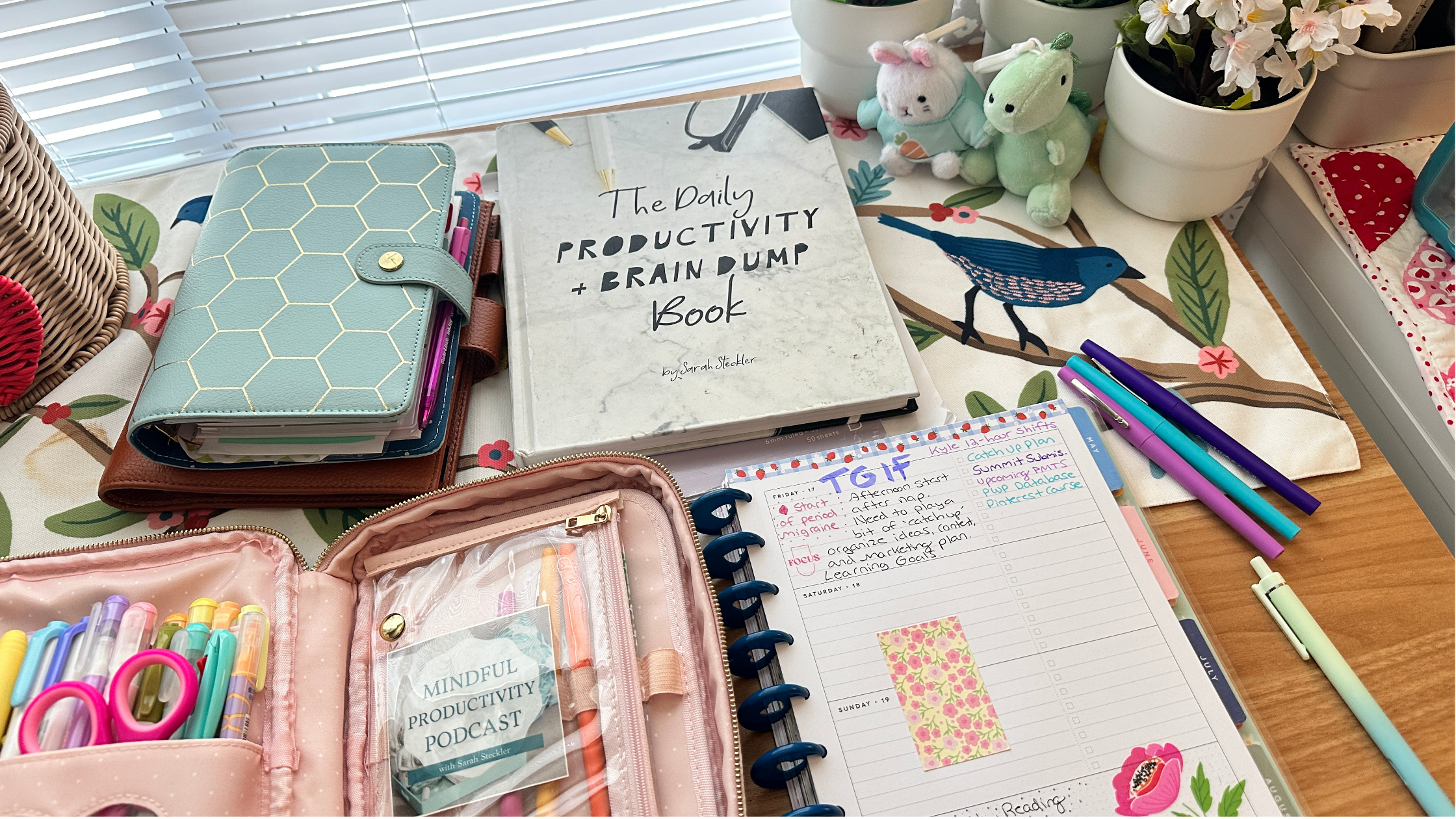
Journaling isn’t just for keeping a daily diary. It can be a powerful tool to plan ahead, track your habits, manage your schedule, and reduce mental overload. I personally love journaling because it brings clarity and helps me stay focused, especially during busy times like grad school.
Here are some of the benefits of journaling:
Boosts your mood: By clearing mental clutter and mapping out your tasks, you feel more in control of your day, which naturally reduces stress.
Increases self-awareness: Writing things down allows you to reflect on your energy levels, habits, and feelings, helping you make more mindful decisions.
Helps clarify your life purpose: By organizing your thoughts and goals, you can get a clearer sense of what really matters to you and how to pursue it.
Improves relationships: When you’re organized, you’re less distracted and more present with the people around you.
Offers a creative outlet: Journaling can be a fun and artistic way to explore your thoughts, whether with colored pens, stickers, or washi tape.
My Go-To Journal System for Staying Organized
One of the most impactful ways I’ve used journaling was during grad school. I developed a system that allowed me to stay on top of assignments, exams, and personal commitments without feeling overwhelmed. You can use this system for any area of your life, whether it’s school, work, or managing your family’s schedule.
The Column System for Tracking Tasks and Events
Here’s how I organized my life with a simple column system in my notebook:
First Column: Days of the Month
Write down all the days of the month in a single column. This gives you a clear timeline of what’s coming up.
Second Column: Days of the Week
Next to each date, jot down the corresponding day of the week. For example, if the 1st of the month is a Tuesday, put a "T" next to it. (Pro tip: I like to use "R" for Thursday—it’s a trick I learned in college, and it helps differentiate between Tuesday and Thursday more easily.)
Additional Columns: Classes or Areas of Focus
If you're in school, each of the next columns can represent a different course. If you're organizing other aspects of your life, these columns can be used for different areas like work, family, personal projects, etc.
Color-Coding with Highlighters
Use color-coded highlighters to mark key tasks, due dates, or events. For example, I’d use blue to highlight exam days and orange for paper deadlines. At a glance, I could see everything that was coming up and plan accordingly.
This system is incredibly flexible—you can adapt it to fit your life, whether it’s keeping track of different family members’ schedules, managing your self-care, or planning out work projects. You can also create columns for things like self-care, workouts, or personal goals.
How to Plan Ahead with Your Journal
One of the key benefits of journaling this way is that it allows you to plan ahead and manage your time effectively. By mapping out everything at the beginning of a month or quarter, you can avoid the stress of last-minute deadlines and overlapping tasks. I used this system to ensure I had plenty of time to study for exams or complete papers in advance, leaving me with more breathing room during busy weeks.
Other Creative Ways to Use a Journal for Organization
Here are a few more ways I’ve used my journal over the years to stay productive:
Weekly Planning Pages
At the start of each week, create a “Week at a Glance” page where you break down your tasks and to-dos. This helps you stay focused on your priorities and reduces the feeling of being overwhelmed by your workload.
Reference Pages
Use your journal to create reference pages for things you need to remember, like a list of staple grocery items, workout routines, or self-care activities. Having everything in one place saves time and keeps your brain from feeling overloaded.
Declutter Your Mind
Journaling is a great way to declutter your mind. Use it to jot down ideas, random thoughts, or worries. This mental dump makes room for clear, focused thinking throughout your day.
Create a Mindfulness or “Buddha Book”
I keep a special section in my journal for mindfulness reminders. It’s a place where I write down intentions, gratitude lists, and little Zen quotes to help me stay centered. This “Buddha Book” is my go-to when I need to reconnect with my true self and focus on what really matters.
Why Journaling Is More Than Just Productivity
Journaling has become a daily ritual for me—not just for keeping track of to-dos but for enhancing my self-awareness and personal growth. It’s a tool that helps me show up better in my relationships and live a more intentional life.
If you’re not already using a journal to organize your life, I encourage you to give it a try. Even just 10-15 minutes a day can make a significant impact on your productivity, time management, and stress levels.
Ready to Start Your Own Organizational Journal?
If you’re feeling inspired but not sure where to begin, I’ve created an Organizational Journal Course that walks you through my step-by-step process. You’ll get templates, tutorials, and all the guidance you need to get started.
Thank you so much for joining me on this journey through journaling! Whether you’re new to journaling or a seasoned pro, I hope these tips inspire you to use your journal in creative and productive ways.
Resources & Links Mentioned:
Journals & Planners
-
This is episode 23 of the Mindful Productivity podcast. And heads up, if you have a journal or a notebook handy, this is going to be an episode that you're going to want to take notes on. Now, I know a lot of my listeners listen on their way to work or while they're driving. So don't worry, you're still going to get a ton out of this podcast. But I will let you know that it's probably going to be one that you're going to want to come back to and reference. It's because I'm sharing with you today my top tips for how you can use a journal to organize your life. You guys, these are strategies and systems I've put in place that have saved my sanity, that have reduced my stress, allowed me to get so much more done. And just all the things that I've done that I started implementing when I was in grad school that really allowed me to get through the program and not miss a beat. I can't wait to dive into everything that I have to share with you. You're going to love it. Welcome to the Mindful Productivity podcast.
I'm your host, I'm Sarah Steckler, and this is the place to be to live a more mindful and productive life. If you're ready to turn daily chaos into calm and start your days with intention, then get ready to join me as we dive deep into mindful living and personal productivity. It's time to connect with your true self so you can live the life you want to live. And it all starts now. Before we jump into today's episode, I want to tell you guys about an awesome free workshop that you can register for right now. It is a workshop that Jenny Eden Berk, Cait Byrnes and I put on, and it's all about how to create space in your life for more energy and productivity. This is an amazing workshop. We dive deep into all the ways that you can get out the door in the morning with less stress, all the ways that you can begin to clear your space, not only mentally, but physically, whether it's in your home or in your workspace, so that you can get more done and not feel so mentally drained at the end of the day. People are loving this workshop.
It was one of the most popular ones we've done. And if you want to register, all you have to do is go to mindfulproductivityblog. Com. Journals have gotten really big this past handful of years. I mean, especially in the past five years alone, I feel like, from coloring books to journals on everything. I mean, I even wrote my own guided journal called 100 Life Challenges that you can find on Barnes & Novel and on Amazon. On. But there's even a Facebook group. And if you're into journaling or bullet journaling or any of that interests you, I highly recommend joining it. It's such a gold mine of resources and ideas. And it's called Bullet Journal Junkies. And that Facebook group has almost 150,000 people in it alone. So it's clear that journaling is not only popular and trending, but it's also something that's really helping people reduce their stress, feel more confident, get more done, and really just has created... It's been this way for people to have this creative outlet that's really fun and empowering. I know I felt that way. So when I decided to go back to school for my master's in 2015, one of the things I was legit most excited about was buying new notebooks, new pens and stickers because those are important.
And when I was younger, I used to do a lot of the dear diary type of journaling, which ultimately turned into this angsty way of me explaining why my life was the worst. And and why everything was always going wrong and poor me, blah, blah, blah. I mean, I don't really blame myself. I was 10, 11, 12. And when you're that age, that's all you really know. Life is overwhelming at that time. But as I got older, I drifted away from writing in my journal in that way. I still love to collect journals like Ross and T. J. Max. And the problem was, is I ended up with this giant pile of really pretty journals that I had no idea to do with. I bought those really cute little boxes that you can buy that have flowers or prints on them. And I would store all these notebooks in these boxes. And I would get really excited. And every now and then I'd open the box and look at all my journals and be like, oh, my God, they're so beautiful. But I wasn't using them. And I didn't get rid of them. And I didn't donate them because I knew there was something that I wanted to use them for.
So being organized is something that has always helped me. It relieves my anxiety. It makes decision making easier. And I flat out I love knowing what I need to do so I don't feel like I'm missing anything. And in college, I was great at this. I would turn the back of the cover of any given notebook into an overview page of the entire quarter. And I want to break this down for you because this strategy was so, so helpful to me. So if you have your own notebook right now, I encourage you to open it up and follow along and create this system for yourself, because whether you're in school or not, you'll be able to use this column system to map out the next three months of your life and see what's going on. So in the first column, I'd write down all the days. So 1, 2, 3, 4, 5, six, seven, right? I'd write down all the days. So month one, there'll be days one through 30, month two, days 1 through 30 or 1 through 28, depending on the month, right? And so forth. And then in that next column, I'd write down the corresponding days next to each day.
So if day one was a Tuesday, then And the next column would have a T for Tuesday. And I did this and so forth. So the only weird thing about it that I did, and I still do to this day, is I always put an R for Tuesday. And it's what my college did when you're registering for classes. And it always just made sense to me because then instead of trying to write T, H, I would just write R. And it also makes it a lot easier when you're trying to quickly reference days of the week. So you don't have to be like, is there Wednesday after this, T, or is there, which day of the week is this? So it just made it a lot easier. Now in the following columns, I'd have a column for each course that I was currently taking. So this would be anywhere from three to four additional columns. So if you're following along with me, we have five columns right now, right? We have the first column for all the days of the month. The second column is the actual days of the week. And then the next three to four columns are either classes you're taking or we'll get to other ways you can use this, too.
So this is where the fun part started, at least for me, because I geek out over this stuff. Each course column then gave me the opportunity to take a note or make note of when due dates were, when finals took place, important exams, and other things. And I also used a color-coded highlighter system. I mean, of course, I did, you guys. So for example, any box highlighted in blue would represent an So are you following along? So if I'm, let's say, the first column was bio or something, and let's say on the 13th day of the second month of the quarter, there was an exam due. So I would highlight that specific box in blue. And sometimes I'd write exam or sometimes I'd write a note, but it just be a way for me to quickly, at a glance, reference things. And this was great because at a glance, I could look at this one piece of paper in my notebook and see where different exams and due dates fell. And it helped me immensely to plan out my quarter and my time management. So one way I did this was when multiple exams or papers were due on the same week, I'd make sure to work ahead.
So if I had a communications paper due week three, but could get the draft done week two and then edit revisions in week two, that allowed me to fully devote week three to studying for that bio exam. So it was really great because where in past times, I'd be like, oh, no, you are just going through the motions of school and then and you realize, oh, my gosh, the third week in, there's all these projects due. This really gave me that big glance ahead of the whole quarter so that I could really plan out each week and each day and be ahead of the game. This is just a taste of the power of what you can do with a blank journal. And this is just one system that I have used. And it's something that you can also use in a variety of ways. So for example, you could use it for different members of your family. So instead of each column representing a course, you have each column represent a person in your family. And then the different color codes could be things like dentist appointments, doctor appointments, recitals, right? Due dates for things.
Let's say somebody has a huge meeting or a presentation or they have to work late, then you can look at that. And it's just a great way to see all of that at a glance, right? So if something falls on the same day for three people, you know that you can plan ahead and make it happen. You could also use this as a way to balance out your personal day to day life and create sections for different things, like a column for self care, a column for workouts, right? It turns into this reverse style habit tracker, where instead of marking down what you're doing as you're doing it, you're actually using this in a way to plan out and map out what you have going on. So for example, if one of the things that you wanted to do was always go to yoga on Tuesdays, you So you go ahead and map that out on your big, giant quarter at a glance. So if you're familiar with bullet journaling at all, I want to pay mention to a similar system used in bullet journaling that was created by Eddie Hope, and this is called the calendex.
So what he does is he sets it up on a two-page spread. And if you're not familiar with what that means, it's basically when you open a journal, there's two pages in front of you. So that's a spread. And he basically creates something where each Each box within a graph, because typically, bullet journaling, you're using graph paper or dot paper, right? Each box represents one day of the year. And what he does is in that box, he'll put a number that corresponds to a page number in his bullet journal. So let's say February 14th rolls around, and he's got a page about what he's going to do or where he's going to go, or maybe there's a special dinner planned. Instead of having to write all those notes out on this two-page spread, he's got a reference number of where to go in the journal to look for it. This makes it really handy, too, because then you don't have to worry about things being in order within your journal. I know I'm covering a lot right now and it's getting really complex, but I will make sure to link a post in the show notes at myvillproductivityblog.
Com/podcast. So you can take a look at what the calendex actually looks like, because once you see it, it makes a lot more sense. And it's hard for me to describe in a podcast over audio. But regardless of how you might want to set up a quarter or a year at a glance page, there have been a number of other ways I've been using my journals over the past six plus years or so that have drastically improved my productivity and reduced my stress. Which brings me to some of the benefits of journaling that I don't think everyone completely knows about, so I want to share them with you. Journaling daily or just on a regular basis can really seriously boost your mood. It's because it's reducing stress. So you're boosting your mood because you're having fun. It's a creative outlet. It's a way to map out what's going on. And let's be honest, I think we all feel a lot less stressed when we have an idea of what is in front of us and what we have to expect for the week ahead. It would be like if you started a class and you didn't even look at the syllabus and you didn't even take a look at how much time something might take you or you didn't listen to the instructor when they're like, you're going to need to read about five hours a week.
If you paid no attention to that, then when it got time to do those things, you'd feel super stressed. So using a journal in this way can really help boost your mood because you're not feeling that way. It can also help you increase your self-awareness. One thing I say is that intelligence stems from our self-awareness. We can spend all this time trying to understand other people, trying to do all these external things, trying to get external validation. But if we don't have self-awareness about where our energy levels lie, what makes us feel the best, what increases or decreases our stress, the ways that we work the best, then it really makes it hard to show up in our lives and feel aligned and feel happy, right? So knowing what you have to do and knowing where to find things and knowing what matters to you is going to drastically improve your quality of life. Journal Handling is also super helpful in clarifying your life purpose. Now, some of us just are born knowing what we want to do with our lives. We know maybe an organization or cause that we want to show up for and serve.
And other people don't necessarily feel that way. But one thing I will tell you, not to segue too much, is that showing up every single day and taking care of yourself means a lot to the world because it means that you're then able to show up in really powerful ways for other people in your lives and everything that you interact with. Journaling helps this because you're building that self-awareness and you're clarifying what's important to you. And as you're making not only just to-do lists, because there's so much more that I use an organizational journal for beyond to-do lists, but it really helps you cultivate your bucket list items and the things that you really want to do and how you really want to feel on a day-to-day basis, right? Because if we're really looking to be more mindful and intentional, it's all about how we're we're feeling on a daily basis and the little things that we're doing every day. Journaling is also a great way to help improve your relationships. It's all interconnected, right? Because the better you're feeling, the less stressed you're feeling, the more you're going to show up in your own relationships.
And two, one thing I loved about setting up this process that I share in my organizational journal course is that when you are clear on what you need to do, you actually follow through and you do it, and then you're able to show up better in your relationship. So when I first started my I was all over the place. When I first started my graduate program, I was really overwhelmed. And I realized that I was spending a lot of time on homework, on building my business, which was needed, but I wasn't finding that balance because I always felt stressed or any time I'd hang out with my husband in the back of my mind, I was always distracted, going, Am I forgetting an assignment? Am I forgetting a discussion board post? When do I want to blog next? So using a journal in this way as a way of organizing your life can drastically improve your relationships because you're going to be more present. Journaling also can help you get to know your true self on a deeper level. And one way is to create a daily journaling page that not only sets you up for organization, but that helps you create a daily journaling prompt or something that you can use to check in with yourself.
This also allows you to get in touch with your thoughts and your feelings. And journaling is great because it helps you let go of shit that's not serving you, right? I talk a lot about this more in-depth in the course about how you can use journaling to declutter your mind, and it is something that saves me regularly. Journaling also helps you because you're creating lists, ideas, tasks, and reminders that are all in one place. And it provides a lot of fun and a great creative outlet. I can't tell you how much fun I have using a journal every week, and most days, not every single day, but having a place to put all these stickers that I seem to hoard and I feel like I have to have a special reason to use them. Now I have a place that I can use them. Using washy tape, using fun colored pencils and colored pens. It's really a great way to have a creative space, especially if you're not in a place right now where you want to get into a bigger hobby or you want to invest a lot in a new project or try something out.
Sometimes I'm like, oh, maybe I'd like painting on canvas, but I'm like, I don't really want to spend a ton of money right now to just see if I like it. So journaling is a lower level expense that not only helps you with organization, but also provides you with a creative outlet, right? And what I love about journaling the most is that you can journal and use an organizational journal in as little as just 10 to 15 minutes a day and drastically improve your organization, your time management, and your productivity. I mean, drastically. In 10 minutes a day. That's pretty amazing. So how can you use a journal to better organize your life? I've shared with you a couple of ways that you can do that. I shared with you my big strategy that I used in school. But I also want to tell you that I'm not done sharing tips with you because these are some of the ways that I've used a journal that have helped me a lot. So first of all, I now have one place for all of my to-do lists and things I want to reference in one place.
So gone are the days of these scattered notes and notepads everywhere and an important sticky note somewhere somewhere on my desk. Yikes. Now I have everything I need in one place. And this saves me because I used to live in this world where, especially at work, I would just have... I'd be in a meeting and I would take a note, and then that note would end up on my desk. And then there'd be a pile of notes. And then it was like, I didn't make time to go through them. One thing I also want to mention is that you can use a journal for different areas of your life. So I love having a journal for just work stuff. And when I was working more of a nine to five, I actually had a journal that a coworker gave me that turned into my reference journal for that job. So every time I went to a meeting, those meeting notes or action items went in my journal. Anytime I was taking notes about a training at work or anything like that, those would go in my journal. Any time I was just at my desk and I had an idea for how we could improve a process or a system or how I could more systematize or automate, there's the word, automate something, it went in the journal.
And this was great because then I had a reference place and I knew that anything that I'd written down was in one place. And then I could add it into SharePoint or add it into a project management system as I went along. But I can't tell you not only how much cleaner my desk was and how much happier my boss was, but how much more mental clarity I had on a daily basis at work. So having a journal also allows me and could allow you to take the journal with you wherever you go. So again, if I have a grocery list, it goes in the journal. Now, it doesn't always have to be written directly on a page within a journal. Sometimes I will put a sticky note or a paper clip or staple, a loose piece of paper in my journal so that I have it with me. So this really helps. Instead of it getting lost at the bottom of my purse, I know I can always pull out my journal, I can flag a page or put a bookmark in my journal, and I always know exactly where I am and exactly where that grocery list is.
Another great thing about this, too, is that you can create a page that maps out what your basic staple grocery items are, right? So then you can take that journal with you and you know, if you forgot your grocery list or something like that, you know what the basic staples that you need to buy every week. Again, the possibilities are endless, right? The reference pages that you can create are endless, and it becomes really, really fun, and you just get more and more organized as you go along. I also use my journal to map out and plan out my my week ahead. I call this my Week of the Glance page. So this was especially helpful during my graduate program. So I talked a little bit about this, but reading and homework assignments really seemed endless. So I would go ahead and I'd break down all of my homework for the week into tasks I needed to complete. So read Chapter 3 pages, blah, blah, blah, blah, be in purple, and the second one would be in orange, so I would know exactly what I needed to do and how much for each class. You could do this for a variety of different areas in your life as well.
And using a journal this way also serves as a great reference book, but also is a great way for you to regularly declutter your mind. So having a place to lay out all your thoughts, all your ideas, your wants, your to-dos, et cetera, makes room in your brain. And it's also helped me better focus on during the day because I'm not left wondering, what am I forgetting, right? Or I'm not doing that when I'm with friends or family or my husband or people that I really want to be in the moment with. And it's also a fun way to create reminders and special pages that remind me to be more mindful, to appreciate the little things, and to take time for myself and my self-care. And I actually have a whole blog post on this specific way of journaling. And I talk about this. And basically, it's something I call a Buddha book, and I'll have to go into more depth on this at some point, too. But it's basically a book I use for Zen reminders, mindfulness reminders, things that I want to be more intentional about. And I really always open it up.
If I take some time, I go out in nature, I open it up and I go, okay, yeah. Here are the reminders for my well-being, my soul, my happiness. And it really helps me bring myself back to center. So I'll link a a note in the show notes as well with how to create your own Buddha Book and the course creation checklist that you can download for that. So let me ask you, are you excited about journaling yet? If you're not into journaling yet, I want to ask you, why not? Because I think a lot of people automatically assume that to journal or to have a journal, that means you have to do your diary all the time. And honestly, that's not something that I do on the regular. I use that. I use different journals to vent or to talk about happy times in my life or whatever. And I think journaling can be a super powerful way of doing that, more like diary type, free writing. Totally think that's important. But I've really found a lot of freedom in using a journal in more of a productivity type of way. So once I found a system that worked for me and I created a system that worked for me, it changed everything.
So I got super excited about making time each day and time each week to write on my to-dos to plan ahead and then follow through. In fact, every Sunday any night, unless something else is going on, I make time, I sit down with a cup of tea, I get in some cozy pajamas, maybe I've just taken a bath, and I sit down at my desk or somewhere cozy on the couch with my Bulldog, and I map out not only what I have to do for the week ahead, but also how I want to feel, what my intentions are going to be, and what I really, really want the next week to look like. Plus making it pretty with stuff like Washi, tape or stickers makes me want to take time to open it and use it on a regular basis. I know I've covered a lot so far. And if you're feeling overwhelmed and you want a more step by step process to start your own organizational journal, I have a full course that walks you through my step by step process, the exact process I use, not only with videos and tutorials, but also with templates and downloadables and printables that you can use to implement in your own journal.
This has been one of my the most popular courses to date. People are so excited to go through this. They've told me that they've mapped out their week, that they have never journaled like this before, that it is a completely different system that they never even thought about. And there's so many ways that you can customize it beyond this and take this course content and these ideas and customize it in your own way to work with your lifestyle. So if you're interested in seeing what that course looks like and enrolling, you can always check it out. You can head to mindfulproductivityblog. Com/courses, and it's called the Organizational Journal Course. I'd love to hear what some of your favorite ways are to use your own journal or notebook. Do you use journals for specific things? Do you have a journal for different parts of your life or different things you're going through? I'd love to hear them. So let me know. I'm always hanging out on Instagram, by the way, @mindfulproductivityblog. Let me know that you listen to this podcast episode. Let me know if you are obsessed with journals as much as I am. And I'd love to hear, too, some of your favorite places to get stickers, some of your favorite places to hunt for journals, all of that stuff.
Thank you so much for listening to this episode. I know we covered a lot, but hopefully you used your own journal to take some notes. I'm so excited to see you guys next Monday, where I have an amazing guest that's going to be coming on to talk about what it means to truly thrive in your life. It's a powerful conversation you're going to want to tune in. As always, you can find all of the show notes on mindfulproductivityblog. Com/podcast. And thank you once again for tuning in. This has been so much fun, and I can't wait to hear what happens for you guys when you start journaling or when you get back into it..