Skills Over Trends: The Mindset Shift for Sustainable Goals & Projects
In this episode, we explore a critical mindset shift that transforms how you set and reach goals in both life and business. Moving away from a "reactive cycle," we discuss how to transition from chasing fleeting trends and software updates to building a foundation of core competencies and critical thinking skills.
Whether you are looking to regain your self-efficacy, start a new fitness routine, or "future-proof" your digital products, this episode emphasizes the power of experimentation and taking action over perfectionism.
In this episode, you’ll learn:
Why "getting in the water" matters more than having the perfect plan.
The danger of building a business solely on moving parts and external tools.
How to create value that translates across different platforms and time.
Strategies for generating energy and taking back control of your daily schedule.
My personal goals for the season, from mindful movement to backend business organization.
Breaking the Reactive Cycle
Life has a way of throwing us into a reactive cycle. Whether it’s a shifting work schedule or external chaos, it’s easy to lose your sense of self-efficacy. To take back control, we have to move away from "chasing trends" and toward "generating energy."
One of the most effective ways to do this is by establishing a central theme for what you want to accomplish next. Much like an anchor errand that helps you get more done in a day, a core theme provides the structure needed to navigate seasons of change.
Why You Should Prioritize Skills Over Software
As creators, it’s tempting to build our businesses around specific tools—like Notion, Canva, or KDP. While these tools are incredibly helpful, relying on them too heavily can leave your business feeling obsolete the moment an update is released.
Instead of just teaching "how to use a tool," focus on:
Core Competencies: Develop expertise that translates across any platform or modality.
Critical Thinking: Equip yourself with the "why" behind your actions, not just the "how."
Unique Perspectives: Infuse your own foundations, like mindful productivity, into your offerings so they remain valuable regardless of tech updates.
Just Get in the Water
We often get lost in the weeds of perfectionism. We ask, "Should I walk for an hour or thirty minutes?" or "What interval pace is best?"
The truth? Perfectionism doesn't matter when you're first starting. If your goal is to reach a new destination, the first step is simply getting your boat in the water—it doesn't even matter which way you're pointed yet.
Action beats the exactness of the action. Whether you're walking 3,000 steps or 10,000, the consistency and the way you feel in your body are what truly move the needle.
Key Takeaways from Episode 221:
Stop Chasing Moving Parts: Build your foundation on your own expertise, not someone else's software.
Embrace Experimentation: Approach your goals with curiosity rather than a fear of doing it "wrong."
Focus on Foundational Outcomes: Ask yourself if you are providing value that can’t be found in a simple YouTube tutorial.
-
You are listening to episode 221 of the Mindful Productivity Podcast. I'm your host, Sarah Steckler, and this week I want to talk to you about what I consider to be one of the most helpful and critical both mindset shifts and actions that you can take in your life and business that transforms the way you move about setting goals and reaching them. Stick around for today's episode if you want to build your critical thinking skills and feel a lot more self-confident in the next thing that you do, create, or take action on.
Welcome to the Mindful Productivity Podcast. I'm your host, Sarah Steckler, and this is the place to be to live a more mindful and productive life. If you're ready to turn daily chaos into calm and start your days with intention, then get ready to join me as we dive deep into mindful living and personal productivity. It's time to connect with your true self so you can live the life you want to live, and it all starts Now.
Hey everyone, welcome back to the podcast. I'm sitting here in my office. It is a beautiful spring afternoon. All of the trees around me are glistening in the sun with their newly formed leaves and buds. The squirrels are enjoying the this whole oasis I've basically built for them and the birds. And every so often I also get to see our groundhog friend Marvin. There's actually more than one now, so I just call them the Marvins. But it is just such a beautiful spring day, and I'm in such a good mood because I just love seeing nature come back to life. And just taking moments to be out there and watch it all is just so lovely. But as I was sitting here thinking about what I'm so grateful for. I was also reflecting on the pace of life right now in my business, and I was like, man, it's been a while since I've sat down and really mapped out some cohesive both personal and business goals. There are chapters in our lives where I think that there's different strategies that work best for attaining the goals that you want in your life, how you want to feel, what you want to be able to do or accomplish, what you want the structure of your routines to look like.
Sometimes that requires a lot more in-depth technical routine and structure, right? Sometimes it really takes mapping out every single thing or even working with like a coach or a therapist to figure out what your roadblocks might be, all that stuff. And then there's other parts of life and goals where you can really just kind of float forward and jump into the joy of experimenting with something and you'll find yourself getting to where you want to go. So it really just depends on what you're working toward. But I was sitting here and I was like, man, I think I'm in a place where I really need to sit down and get really specific on what I want, because lately it just feels like so much is out of my control again. And my husband has a crazy work schedule that tends to impact mine, and so right now he doesn't always have the same hours that he's working, and my bulldog hates that cuz she loves her routine. So so her sleep gets disrupted and so does mine. So I've just found myself in kind of this reactive cycle, and I was like, ooh, how can I take that back and start doing things to generate energy, generate the start of my day, and take back a little bit more of that feeling of self-efficacy, right?
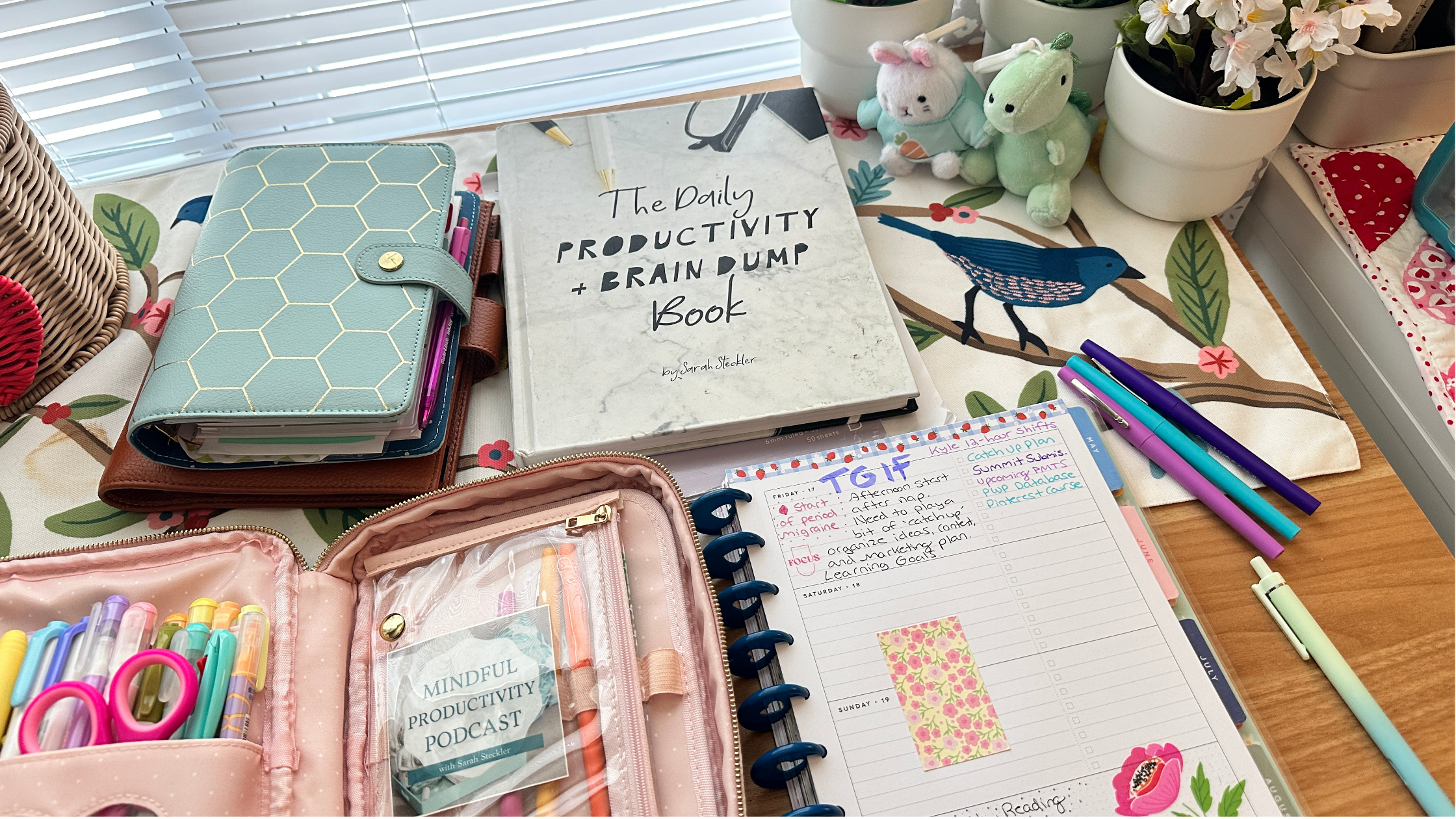
But in that, I was thinking, and I wrote down a bunch of notes here in my daily productivity and brain dump book, which I still like love so much. I use it almost every day since I've created it. I think I made this thing in 2019. And people also always tell me it's like the simplest planner that they've ever bought, but somehow the most helpful one that they've ever bought. So if you want to check that out, I do have some other episodes on it. I'll link in the show notes as well. But I wrote a bunch of notes in here about what I think— I think it can be summed up into one critical mindset shift, but I'll kind of go through these and we'll just kind of have a little discussion as I do on the podcast. But I was really thinking about how I want to go about a couple things. So one, and I guess just by virtue of explaining this, I'll share some of my goals in my life and business. So one thing is that I really want to become more active again. Oh, back, back decades ago now, not decades, but maybe a decade ago, I was so much more active.
I used to be the kind of person that would run miles every day, go to the gym a lot, and I remember annoyingly so telling my friends like, I never go more than 2 days without working out. Now, oh my gosh, it's, it's kind of the opposite, right? Like, when was the last time you worked out? And so I really want to get back into connecting with my body, listening to my body, and not kind of avoiding it. And so we have a treadmill set up, which is really nice because it gets so hot here and so cold in the winter. So that'll be something something that can help me be more consistent. But I definitely want to be outside more and doing that. I also want to be cooking more, um, learning how to cook a couple different things from scratch when I have time, and really just kind of reevaluating what kind of food, you know, I'm choosing to eat and all that kind of stuff. So those are some of my personal goals. And then on the business front, I'm really getting excited about coming up with more content plans. Both for the podcast here, what I want to talk about with all of you guys, how I want to pace the show again.
I really want to get back into these weekly episodes, right? For just over 2 years— I started this podcast in 2018— for 2 years straight, I did not miss a Monday episode drop. Like, it was— even if it was Sunday night at midnight, I would make sure to get an episode out. And that's just also, I think, a sign of the times and my lack of burnout in that point in my life. But I want to get back to probably not being as strict as that because it's not necessary. Consistency can take a lot of forms, but I want to get back to really being more consistent with this show because it's not only fun to hear from all of you and how helpful it can be, but it also provides a sense of structure to my time in my life. So that's like one of the big goals. And then the other big goal that's not really like a, a revenue generator or moneymaker is just really with a fine-tooth comb going through the backend of my business and organizing it in an even deeper way. Really looking at all of my SOPs, looking at where everything is stored.
I use Google Drive primarily in my business, but I also wanna have more in-depth spreadsheets that link everything together. So, if something were to happen, uh, to me, or if I were to like desperately hire somebody, uh, as, you know, to come in and help me with something, it would be that much easier for them to be like, oh, this is where this is and this connects to this project, all of that. So those are some of just like the baseline huge projects in my life that I'm working towards. I think it's really important to come up with a main theme in your life that you want to be working towards, whether that's kind of like, you know, the wellness wheel and looking at like, is it health? Is it relationships? Is it work? What's like the main thing that really would help drive you? Once you have one core thing that you wanna do, it's kind of like how if you have nothing to do at all during a day, the time just can kind of escape you. But if you have one core errand that you need to run that gets you to leave the house, then all of a sudden you can stick other things to it and get a lot more done.
And that's kind of the same with like creating a central theme to what you wanna accomplish next. I was thinking about some of the mindset shifts in my business and my life. And one of the things that I think we're all guilty of is that we will often chase a goal, but not chase the actions behind it. And this is kind of like the biggest shift that I think has really helped me in that it's important not to build a foundation of how you take action based on moving parts. So I'll give you some, some different examples with this, but One thing is with my new walking goal, because that's really what I want to focus on, is like walking, increasing my step count, but also just enjoying walking, enjoying listening to audiobooks or podcasts or even just trance music. You know, I love listening to all that when I'm walking. I could get really swept up in how long should I walk every day? Should it be an hour? Should it be half an hour? Should I do, you know, interval pace walking? Should I walk on my treadmill more than I walk outside?
Like, what's best? What kind of shoes should I have? I could get lost in in the weeds of all these things, right? And that's gonna prevent us from taking action, first of all. But then I also start chasing all these random details of the goal that actually don't matter, especially when you're first starting. When you're first starting anything, perfectionism doesn't matter at all. I mean, it never should. But when you're first starting anything and you're moving in a direction, even if your goal is to go to Japan on a boat The first step is just getting that boat in the water, right? It doesn't even matter like which way you're pointed. And I know that sounds silly, but that is so true about things that we do in our lives. Just get in the water, right? Like, just put your shoes on and get out the door and go for a walk. Don't get caught up in what podcast do I want to listen to? Should I listen to music? Should— just go. Just do the thing and embrace the mindset of experimentation and curiosity. And how does this feel? And you'll change things along the way.
That's why— that's how people become experts in things, right? Like they've started a bakery and they've been doing it for so many years and now they know the ins and outs of it, not because they read some book on being a baker, which I'm sure could also help, but because they went in and they did the thing, right? And so anyway, there's nuance to that, but I think you get what I'm saying. So that's the, the first thing. And this also takes the shape of how you run your business. I have created many programs, many courses in my business that do rely heavily on external software, right? Like in Publish With Purpose, we primarily use KDP to publish planners. In my business, that means I'm dependent on the changes that they make because that affects my program and what I teach my students, right? The same thing could be said about a program I created years ago called Pretty Productive Life. It was based inside of like the Notion ecosystem, so I spent Oh my gosh, I think it was like weeks and weeks and weeks. I can't remember how many hours. I think it was like 500 hours by the time I tracked it all.
But it was so much time I spent building this whole productivity ecosystem in there. And then, and this was back in 2021, I think. And then Notion made a bunch of changes. Everything still works. It's great, but there's so much more you can do in there now. So in order for me to feel like I could bring that program back to life or put it back on the market for people to buy, it almost feels obsolete, right? Because so much of it is dependent on how I teach Notion and now icons are in different places, right? The same thing happens with Canva. I teach how to use that inside of Publish with Purpose. When they make updates, I'm gonna have to make updates, right? You get it. But here's where the real shift comes into play because you can either, in your life and business, create a goal. Or create a project or create a digital product that's based off of someone else's core thing, right? A software tool, even an idea or a theory or something like that. You can do that, but what it will likely set you up in is a continual chase of you're never actually in front of, you're never the one actually steering the boat, right?
If they make an update, you make an update. If there's big changes, there's gonna be big changes to your business. So if you were to run a business based on any one tool alone, right? Or you were chasing some new tech thing, then essentially what ends up happening with a lot of people is that they're chasing trends instead of learning skills. And not to say that there isn't skills learned, right? Like when you're experimenting and doing things and trying new technology, But I think we're also in this place, especially with all of the AI hype and all of that, where there's this push to get things out and ship things faster, ship things faster, create things faster. Oh, look, you can do this thing in 3 minutes instead of 3 days. How great is that? You can go listen to episode 220 if you want my thoughts on all the hype stuff behind AI. But I think it's actually a really good opportunity at any given point in your business to stop and pause and slow down and ask yourself, where can I invest my time and energy in really equipping myself with critical thinking skills around something, perspectives, and core competencies that are going to help me essentially translate what I know across space and time in many ways, right?
So instead of building your business around someone else's tools or ideas and chasing that forever. Instead, you can look at it as what are your own foundational takes or expertise around something, and how can you then implement that into virtually anything, into any software tool, into any modality. Now, sometimes that doesn't always work, and obviously there's going to be nuanced things that happen when you teach inside of any container. But I'll give you one example that has worked really well for me, and that is I have quite a few different ways that I teach productivity, right? I bring in mindfulness to it, and I've been running this podcast and kind of the idea of that since 2018. So there's like a lot of different— at the time there was like not as much online about Managing your own energy capacity, thinking about your own brain and how you might think differently or work differently. Like, the whole neurodivergent conversation also was not happening at that time, really, on the internet. Maybe it was, but people didn't have the language and the verbiage for it. So a lot of the foundations of what I teach when it comes to being productive and staying organized in your life and business fall back on this concept of mindful productivity and all the stuff I have built in behind it.
And so when I created my most recent course, Wonderful Workspace, which is one of two of my big signature programs, it's one of— there's only two programs where I actually offer support calls and like ongoing support calls perpetually. So students get lifetime access to those. And on average, we do one a month. Sometimes we have live rounds of things or we have like Skill Labs or workshops that we do. Those are the only two programs that I do that. Why am I sharing that? So the point is that inside of Wonderful Workspace, I have a bunch of tools that I teach people. I teach people how to use the tools within it. So we go through Google Tasks, we go through setting up your Google Drive, we go through all these things. And that does require me to know how those tools work. However, What I'm actually teaching is not just how to use it, 'cause I mean, you could just go in there and figure it out. You could ask the internet, you could scour YouTube videos, you could figure that out. What I actually teach inside of it is how to implement mindful productivity strategies into your business, into your business, and how Google Tasks can help you with managing your energy, how you can use Google Calendar to really set boundaries with yourself and your clients and your students and how that all maps together.
Now, what that does is when I'm creating the core foundations of that curriculum, it's not based inherently on Google Workspace alone. It's based on my expertise and the foundations of, like, the core concepts and outcomes that I want students to be able to gain from it, right? So even when Tasks makes an update or Google Calendar suddenly works completely differently, right? Hopefully not. Those things I'll have to tweak within the course, but essentially what I'm teaching people and why they bought the course and what they're actually learning from it doesn't change. Does that make sense? So when you think about your business and what you create, ask yourself, am I merely teaching the concepts laid before me in another software tool that could be found anywhere else, or am I instilling a different kind of value in it by bringing in concepts to it that you couldn't learn elsewhere, right? So I just, I think that's really an important distinction in how creators right now are making things, not only for the value that you drive through your programs and that people gain, but also for your own mental sanity in how you're creating things.
Because if you're going to simply create something that teaches people how to do a specific thing inside a specific software tool or program, and that alone is it, not that that's not valuable, but if you are promising updates or if you want to continue to sell that product, you may become quickly exhausted by having to update it constantly. I still update my programs, but with Publish with Purpose, for example, KDP can make a ton of updates throughout the year, and I keep my students— keep— I keep the pulse on that for them and I update them. But the whole course itself doesn't have to be updated every single time there's an update like that. I can do an annual review and update things, and it feels a lot more manageable, versus if the course wasn't surround— if, if Publish with Purpose wasn't built around how I teach people how to create high-value journals and planners and walk them through not only the ideation process where you're really creating unique ideas and showing them how to create outcome-driven planners, if it didn't have that in it and it was simply just like, here's how you create pages, here's how you throw it on KDP, it wouldn't be as valuable and it would also be more difficult when things were updated.
So that's that. And it also kind of comes back to, you know, in your personal life, when you're setting up your goals, don't chase all the trends. Don't chase all the trends of everything. Really just stick to what your main goal is in terms of your feeling and the general direction and focus more on the actions you are taking because that's what matters. It's the actions you are taking, not the exact actions that you are about to take. I feel like this is difficult to explain. I'm doing a poor job of doing it. But again, coming back to walking, it's like it doesn't matter how many steps you take a day, whether that's 7,000 or 12,000 or even 3,000. What matters more is, are you doing it in a way that, that's consistent? Are you feeling better in your body? Are you reaching your fitness goals that you're wanting to set? Is it helping you improve your mood? Like, those are the things to notice versus, oh well, so many 'People on Reddit are doing this many steps a day and they're doing this specific interval walk or they're doing this workout on a treadmill at this incline for 10 minutes, therefore I should do that' is such a— it's a less inspiring and invigorating way to go about your goals.
So anyway, I'm gonna wrap this up because I feel like I'm rambling at this point, but I hope that there was something inside this episode that just kind of brought it home how important it is to take action and find your own core foundation of what that action can be versus chasing a trend, focusing on skill building versus trying to attain some goal that's not even something that you're creating, right? That someone else is facilitating, that you're going, oh, that looks cool, but it's not actually, it doesn't actually matter in the big realm of what you're working towards. So anyway, hope that helps. Hope that makes sense. I will see you back here on the podcast next Monday, and I hope you have a wonderful week ahead and good luck with the next thing that you're working on.