
Episode 57: The 4-Step Process to Map Out Your Day for Optimum Productivity
To-do lists get too long, we don't know where to start, we fall into decision-fatigue and major overwhelm, and this all happens before we even get started on our day! No wonder it can feel so hard to be productive! Today I'm sharing my 4-step process that gets you to take action, declutter your mind, bring in solid mental clarity, and map out your target tasks so you actually take action on the day and your goals ahead.

How to Map Out Your Day for Optimum Productivity: A 4-Step Mindful Process
Have you ever woken up with a million ideas racing through your head, only to feel paralyzed by overwhelm before you’ve even had your first cup of coffee? If you’re a creative entrepreneur or a deep thinker, you know the feeling. It’s not that you’re lazy—it’s that you have so much going on that choosing a single priority feels impossible.
In this episode of the Mindful Productivity Podcast, I’m sharing the exact 4-step process I use every morning to declutter my mind and set myself up for a sustainable, productive day. This method has helped me beat decision fatigue, boost my efficiency, and finally reclaim my evenings.
Best of all? You don’t need a fancy system to start. Whether you use a blank journal or my Daily Productivity & Brain Dump Book, these steps will help you move from chaos to calm.
Step 1: The Structured Brain Dump
Writing things down is magic. It frees up the mental energy your brain usually spends on the "background narrative" of don’t forget, don’t forget.
Instead of a random list, try a structured approach using these three categories:
What I Cannot Control: List the external stressors (the weather, how others react, or even how long it takes the dog to find the perfect spot in the yard). Acknowledging these helps you let them go.
What I Can Control: Focus on your responses—how you move your body, how much water you drink, and how much time you spend on your phone.
What I Will Change: This is your empowerment zone. Decide to change your wind-down routine or how you respond to stress.
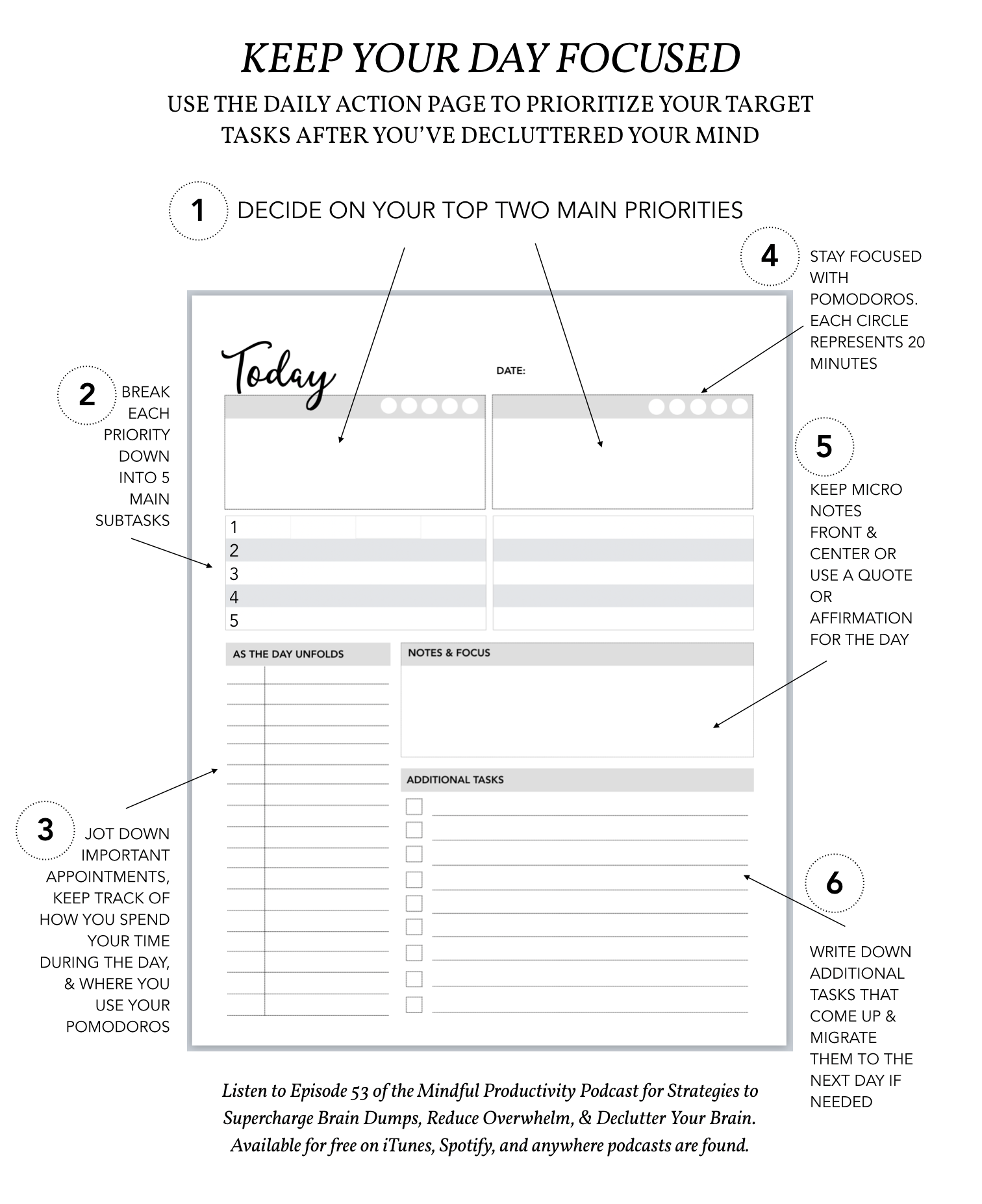
Step 2: Identify Your Top Two Priorities
Once your mind is clear, the real priorities usually float to the surface. Instead of a mile-long to-do list that you'll never finish, pick just two specific main goals for the day.
For example, my priorities today were:
Recording two podcast episodes.
Organizing the backend of my business tasks.
Step 3: Break Priorities into 5 Sub-Tasks
Big goals are intimidating. Step 3 is about removing the barrier to action by breaking each of your two priorities into exactly five small sub-tasks.
If your priority is "Record a Podcast," your sub-tasks might be:
List out topic ideas.
Outline the episodes.
Record and edit.
Update the task in your project management tool (like Asana).
Create social media quote graphics.
Seeing only five steps makes the project feel doable rather than daunting.
Step 4: Map Your Day with Pomodoros
Now, it’s time to look at how your day actually unfolds. Check your calendar for meetings or appointments, and then slot in your tasks using the Pomodoro Technique—20 minutes of deep, focused work followed by a short break.
Why 20 minutes?
It prevents "task switching," which drains your brain power.
Most sub-tasks actually take less time than we think when we're fully focused.
You only need about ten Pomodoros (roughly 3.5 hours of focused time) to make massive progress on your high-priority projects.
Mindful productivity isn't about doing more; it's about being intentional with the energy you have. By clearing the "mental plaque" first and then focusing on a few small, manageable steps, you’ll find you have more energy at 3:00 PM and more peace when you close your laptop for the night.
Ready to try it? Scroll down to learn more about how you can use the Daily Productivity & Brain Dump Book!
How to use the daily productivity page inside The Daily Productivity & Brain Dump Book
Follow along on Instagram


